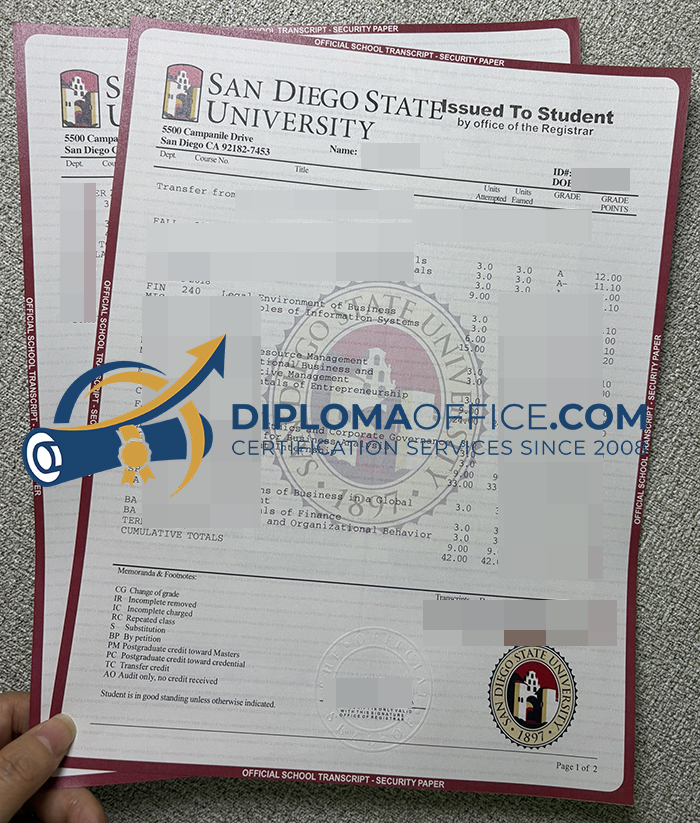
Core Definition & Two Official Types of SDSU Academic Documentation
Every student or graduate of San Diego State University needs verified academic records for transfers, graduate school applications, employment background checks, and professional licensing. The official comprehensive academic summary issued by the university’s Office of the Registrar is SDSU transcript, which falls into two legally distinct formats with separate intended uses.
Unofficial records are free, instantly accessible through the my.SDSU student portal under the Academic Records tile, and display identical course, grade, unit, and GPA data as certified versions. They lack university watermarks, digital signatures, and embossed seals, so admissions committees and employers rarely accept them for formal submissions. Unofficial copies serve personal review: tracking semester GPAs, planning course sequences, or self-verifying completed degree requirements.
Official certified records carry institutional authentication. Electronic PDF versions include a verifiable GeoTrust digital blue ribbon signature readable via Adobe software, while physical paper copies feature embossed university seals and security paper stock. All official documents cost $15 per copy, plus additional postal surcharges for international shipping, and follow strict processing timelines separate from free unofficial portal access. Critical edge case: students who completed all coursework before Fall 1987 cannot order electronic versions and must submit mail-in paper requests only.
Detailed Content Layout & Academic Data Dimensions
The document standardizes uniform data blocks to meet regional accreditation and national transfer credit rules, organized into five fixed sections for readability and institutional verification. The opening segment lists legal full name, RedID student identification number, date of birth, admission semester, and graduation posting date once degrees are finalized (3–5 weeks after final semester grades publish). Transfer credit summary follows, listing total accepted semester units from external community colleges or four-year schools without reproducing outside institutional coursework; applicants must request separate transcripts from prior schools to submit full transfer documentation.
Core semester coursework occupies the central section, listing each term’s course codes, titles, letter grades, attempted units, earned units, semester GPA, and cumulative undergraduate or graduate GPA. Academic honors including Dean’s List, Latin honors, and completed minor/certificate programs are printed at the bottom of each certified record. No financial holds appear directly on the document, but unpaid student account balances block all official order processing until cleared via the university bursar’s office.
Order Channels, Processing Timelines & Delivery Methods
Three authorized ordering channels comply with registrar policy; phone, fax, and direct email requests are rejected entirely. Online ordering via Parchment is the fastest option for post-1987 students: certified electronic PDFs deliver within 24–48 business hours, while mailed paper copies take 2–3 business processing days before USPS dispatch. Manual mail-in orders require a signed paper form, check payment, and standard processing windows of 3–5 business days after physical receipt at Student Services West. In-person pickup at the registrar counter requires valid photo ID and on-site payment for immediate hard-copy release.
Peak timing risks apply at semester start, final exam weeks, and graduation cycles, where processing can extend an additional 5–7 business days. Holiday shutdowns pause all fulfillment, including federal and university observed holidays from New Year’s to Christmas break. Order tracking lives exclusively inside the Parchment account dashboard, where alumni monitor delivery confirmation for electronic and mailed shipments worldwide.
Real-World Use Cases & Official Acceptance Rules
Each format has rigid eligibility rules for external parties, a critical detail many applicants overlook when submitting applications. Graduate program admissions, out-of-state university transfer applications, teacher credential licensing boards, and competitive corporate hiring background checks require official documents sent directly from SDSU to the receiving institution. Paper copies mailed to the student home address receive an “Issued to Student” stamp; once the envelope seal breaks, third parties classify them as invalid official documentation.
Domestic undergraduate transfer applicants submit electronic certified PDFs to SDSU’s admissions inbox for streamlined credit evaluation, while international graduate applicants often request sealed hard copies for visa and overseas university enrollment submissions. Unofficial portal downloads remain acceptable only for internal university advising meetings and personal academic planning, never formal external credential reviews.
Common Pitfalls & Troubleshooting Tips
Most delayed or rejected orders stem from avoidable administrative oversights. Students should confirm all final grades and degree postings via unofficial portal records before purchasing certified copies, as rush orders cannot be held to wait for late semester grade updates. Name mismatches between current legal ID and student records require a name change submission to Enrollment Services before ordering accurate documents. Pre-1987 alumni frequently attempt electronic orders that automatically cancel; mail-in paper forms remain their sole viable ordering pathway.
For lost or undelivered shipments, users first check Parchment tracking status before contacting the registrar, as SDSU cannot intervene on USPS international or domestic transit delays. Electronic PDF authentication failures usually resolve by opening the file in official Adobe software rather than browser-based preview tools, which strip the verifiable digital signature ribbon required for institutional validation.
Conclusion
Whether for graduate admission, career advancement, cross-state academic transfer, or personal academic record-keeping, understanding formatting, ordering logistics, data structure, and acceptance standards eliminates costly delays in credential submissions. Distinguishing unofficial self-reference copies from authenticated official versions, adhering to processing timelines, and using authorized ordering channels ensures users submit valid, recognized academic documentation aligned with SDSU registrar official policy.