Institutional Background & Official Accreditation
Hogeschool Saxion, operating internationally as Saxion University of Applied Sciences, is a prominent Dutch HBO (Higher Professional Education) institution formed in 1998 through the merger of Hogeschool Enschede and Hogeschool IJsselland, with educational roots stretching back to 1875. It runs three fully equipped campuses across eastern Netherlands: Enschede, Deventer, and Apeldoorn, hosting over 25,000 total students including 2,500 international learners from more than 80 global countries.
The school holds full NVAO accreditation, the official Dutch-Flemish quality assurance body for higher education, validating all its associate, bachelor, and master programmes as nationally and EU-recognised qualifications. As a core member of the EUDRES European university alliance, Saxion builds cross-border academic partnerships with applied science schools across Finland, Germany, Austria and Eastern Europe, expanding exchange, joint research and dual-degree pathways for all enrolled students. Its regional location offers seamless access to Dutch manufacturing, tech and sustainable fashion industries, laying a practical foundation for every student’s academic journey.
Programme Portfolio & Practice-Oriented Teaching Model
Unlike research-focused Dutch universities, Hogeschool Saxion centres its curriculum on project-based, work-integrated learning, with roughly 50% of study hours dedicated to real industry assignments, internships and group consultancy projects for local and multinational enterprises. It delivers over 100 full-time and part-time qualifications covering three tiers: two-year Associate Degrees, four-year Bachelor HBO tracks, and one to two-year Master’s degrees.
High-demand English-taught pathways for international applicants include International Business, Applied Computer Science, Sustainable Fashion & Textile Technologies, Hotel Management, Robotics Engineering and Forensic Science. Unique specialisations such as Applied Nanotechnology and Circular Textile Innovation distinguish Saxion from other Dutch applied universities, aligning curricula with global green economy and digital transformation trends.
Mandatory internships start from Year 2 of bachelor programmes, requiring students to solve live business or technical challenges supervised by industry practitioners alongside university lecturers. Small classroom sizes guarantee personalised tutoring, while honours tracks and top talent programmes provide advanced research opportunities for high-performing learners to boost competitive advantages post-graduation.
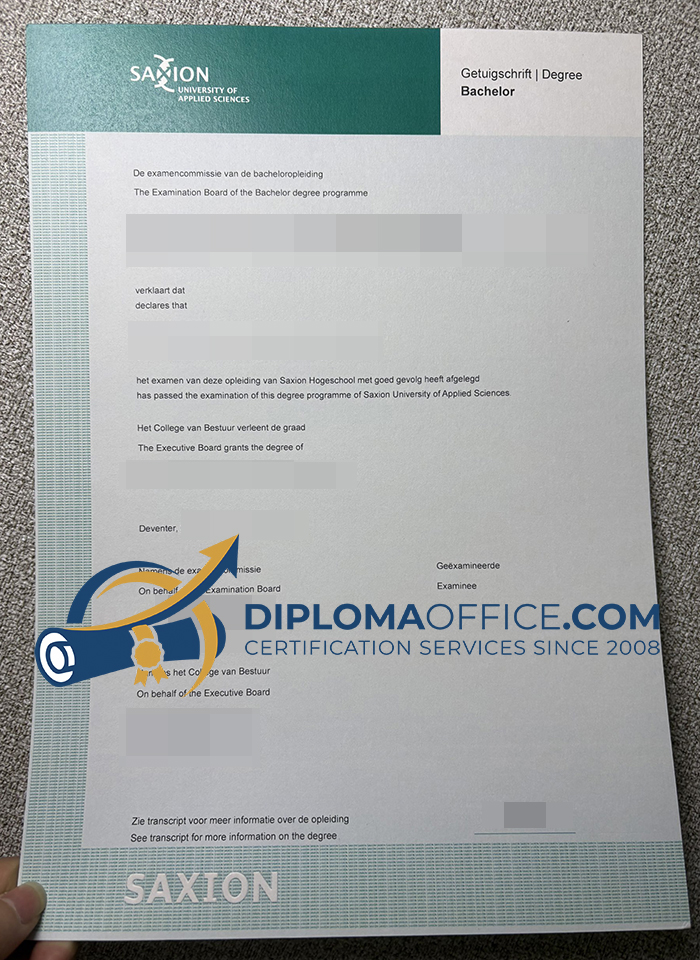
Global Recognition & Labour Market Value of Hogeschool Saxion diploma
Graduate employability data from the official 2025 HBO Monitor confirms the strong market weight of a Hogeschool Saxion diploma, with measurable career outcomes verified by national Dutch higher education surveys. Statistically, 81% of Saxion graduates secure matching roles immediately after graduation, 89% land industry-relevant jobs within three months, and 77% work directly within their studied discipline. Technical fields like Applied Computer Science record a 95% graduate employment rate within 18 months, with average starting gross salaries around €2,500 monthly for full-time professional roles.
This diploma carries full recognition across the European Qualifications Framework (EQF), enabling graduates to seek work permits and professional registration in all EU member states without additional qualification validation. Many multinational firms operating in the Netherlands, Germany and Belgium actively prioritise Saxion alumni due to the school’s industry-linked training model. Additionally, holders can pursue further academic advancement: roughly 13% of IT and engineering graduates enrol in pre-master or full postgraduate programmes at Saxion or neighbouring research universities such as the University of Twente.
International Student Support & Campus Facilities
Hogeschool Saxion delivers comprehensive support services tailored to non-EU and EU international students to ease relocation and academic adaptation. Core resources include dedicated international admissions teams, visa guidance, affordable campus housing assistance, free Dutch language workshops and cross-cultural student associations. Entry criteria for English-taught bachelor programmes demand IELTS 6.0 or equivalent TOEFL/Cambridge scores, alongside secondary school transcripts verified via Nuffic for overseas applicants to confirm equivalence with Dutch HAVO/VWO standards.
Campus infrastructure features specialised labs for textile material testing, cybersecurity server suites, mechanical engineering workshops and media production studios, all accessible for scheduled student projects throughout semesters. Career Services maintains a vast network of regional and international corporate partners, organising recruitment fairs, one-on-one CV coaching and interview preparation sessions to connect learners with internship and graduate job openings year-round.
Long-Term Career & Further Study Pathways
Saxion graduates split into three clear post-graduation trajectories: direct industry employment, entrepreneurial ventures, and continued higher education. Business and fashion alumni frequently launch sustainable startups supported by Saxion’s on-campus innovation hub, while engineering and ICT graduates progress to technical specialist, project management or R&D positions at tech manufacturers and software agencies.
For learners aiming to upgrade their credentials, Associate Degree holders can top up to the third year of a matching bachelor programme, while bachelor graduates qualify for Saxion’s industry-focused master’s tracks including MBA, Facility & Real Estate Management and Innovative Textile Development, some offering double diplomas with UK and European partner universities. The school’s lifelong learning division also provides short professional upskilling courses for alumni seeking career advancement mid-career.
Closing Summary
As one of the Netherlands’ most reputable applied science institutions, Hogeschool Saxion balances rigorous practical training, internationally accredited curricula and robust graduate employment support. Its industry-aligned teaching, cross-European partnerships and widely recognised qualification framework make it a top choice for students targeting hands-on, job-ready higher education in continental Europe.