Foundational History & Institutional Profile of UNIMORE
Officially abbreviated as UNIMORE, the University of Modena and Reggio Emilia traces its academic roots back to 1175, ranking among Europe’s oldest continuously operating higher education institutions. Originally built around a prestigious law school under the patronage of the Este noble family, the university merged its Modena and Reggio Emilia campuses in 1998 to form today’s unified multidisciplinary institution.
Geographically positioned in Emilia-Romagna, Italy’s industrial and manufacturing heartland, UNIMORE operates dual main campuses 20 kilometres apart, plus satellite teaching hubs in Mantua and Carpi. Current institutional data records roughly 30,000 enrolled students, including over 2,500 international learners, 13 specialised departments, 18 dedicated research centres, and more than 1,400 academic and administrative staff members. Classified as a public research university under Italy’s national education framework, UNIMORE holds consistent global rankings between 701–850 in QS World University Rankings, balancing historic academic heritage with modern industry-aligned education.
Academic Programmes, English-Taught Tracks & Learning Infrastructure
UNIMORE delivers a full spectrum of accredited study paths covering bachelor’s, master’s, single-cycle integrated degrees, and doctoral research programmes, totalling 96 official courses across five core disciplinary clusters: Technology, Life Sciences, Health, Society, and Pure Science. A standout draw for overseas applicants is its portfolio of six fully English-taught master’s degrees, including Advanced Automotive Engineering, International Management, Electronic Engineering, and Physics, alongside 13 English-language PhD tracks focused on innovation and clinical research.
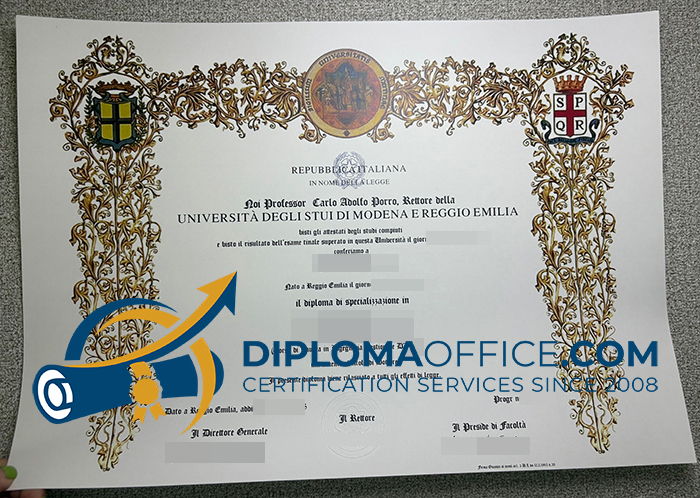
Teaching infrastructure supports both in-person and blended learning: seven university libraries, ten academic museums, advanced automotive engineering labs, regenerative medicine research facilities, and dedicated career coaching hubs. The university designs curricula to integrate hands-on practice, mandating formal internships for most undergraduate and postgraduate cohorts, with nearly 5,000 annual corporate placement opportunities sourced from regional manufacturing, automotive, biomedical, and agri-food enterprises. Every graduate receives a standardised UNIMORE diploma paired with an EU-recognised Diploma Supplement, detailing credit frameworks, learning outcomes, and European Qualifications Framework (EQF) alignment for seamless global credential verification.
Research Strengths & Regional Industry Partnerships
Research forms a core pillar of UNIMORE’s institutional mission, with seven prioritised high-impact research verticals: advanced automotive mechanics, smart information communication technology, stem cell regenerative medicine, sustainable nanomaterials, genomic molecular healthcare, environmental food science, and social policy innovation. Its proximity to luxury automotive manufacturers Ferrari, Maserati, and Lamborghini creates unmatched industry collaboration, with joint research labs, student co-development projects, and exclusive graduate recruitment pipelines for engineering graduates.
Beyond automotive sectors, UNIMORE maintains formal partnerships with regional agri-food consortia, ceramic manufacturing groups, and public health authorities, facilitating technology transfer from academic labs to commercial production. The university regularly launches student spin-off startups, supported by dedicated innovation offices and regional government funding for young researchers, bridging theoretical academia and real-world industrial demand.
Graduate Employability & Global Credential Value
Independent national graduate tracking report AlmaLaurea 2026 confirms UNIMORE leads large generalist Italian universities in post-graduation employment metrics: master’s graduates hold a 92.6% employment rate five years after graduation, while bachelor’s graduates record an 85.9% one-year post-degree employment rate, outperforming many larger Italian metropolitan universities. Most graduates secure permanent full-time contracts within 12 months of finishing studies, with competitive salary benchmarks in engineering, management, and clinical fields.
Globally, the UNIMORE diploma carries full recognition across all European Union member states via the Bologna Process, and holds widespread acceptance for postgraduate admission and professional licensing in North America, Asia, and Oceania. International graduates can complete apostille legalisation through Italian consulates to validate their credentials for overseas work visas, further boosting cross-border career mobility. The university’s dedicated international student office provides step-by-step guidance for credential verification, immigration paperwork, and cross-continental job search support.
International Student Experience & Support Services
UNIMORE prioritises inclusive international student integration through structured welcome weeks, free Italian language courses, multicultural student associations, and mental health counselling services for overseas learners. Both Modena and Reggio Emilia offer affordable student housing, accessible public transit between campuses, and rich cultural amenities—Modena’s historic cathedral is a UNESCO World Heritage Site, while Reggio Emilia is globally renowned for progressive early childhood education research.
Additional support includes visa application assistance, scholarship matching for non-EU students, and exchange coordination via Erasmus+ global mobility networks. International learners gain access to the same internship, research lab, and career fair resources as domestic students, removing barriers to practical training and professional networking during their degree journey.