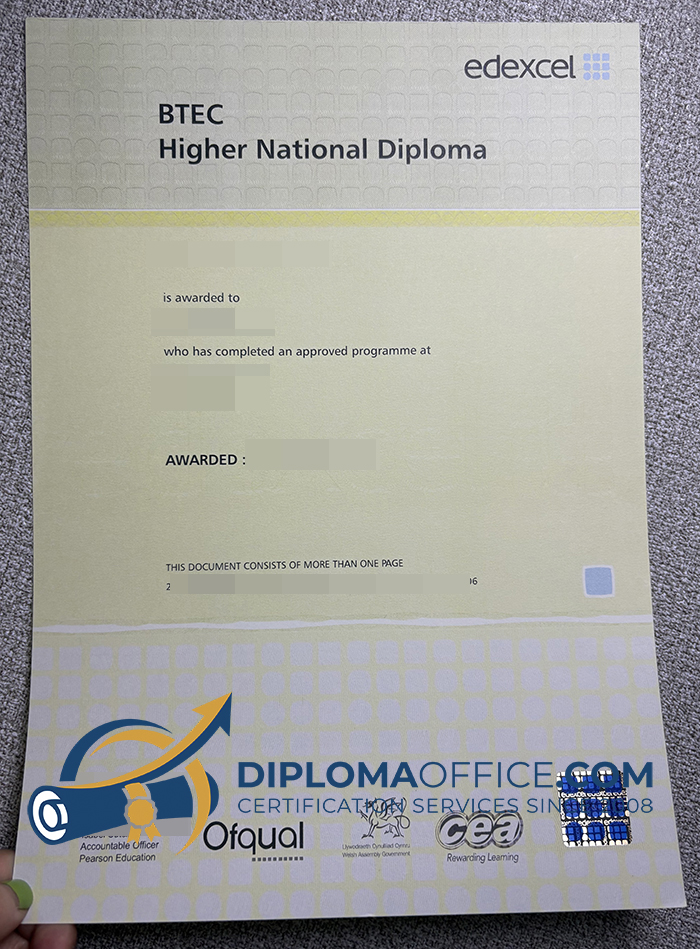
As a globally recognized vocational higher education qualification regulated by Pearson, the BTEC Higher National Diploma is a UK Level 5 credential designed to bridge academic learning and real-world industry requirements. Rooted in the UK’s Regulated Qualifications Framework (RQF) and accredited by the Quality Assurance Agency for Higher Education (QAA), this qualification targets learners aged 18 and above, including school graduates and working professionals seeking skill upgrading and academic advancement. Different from purely theoretical university courses, it focuses on practical competency cultivation, making it a trusted pathway for both employment and further higher education worldwide.
Core Positioning and Academic Level
The BTEC Higher National Diploma corresponds to the first two years of a standard three-year British undergraduate degree, sitting at Level 5 of the UK higher education system. It differentiates itself from traditional academic diplomas through its vocational orientation, balancing systematic theoretical knowledge and hands-on professional training. Its predecessor, the BTEC Higher National Certificate (HNC, Level 4), serves as a foundational stage, while the diploma delivers in-depth, industry-aligned learning outcomes. Governed by strict official standards, the curriculum is jointly developed with industry experts, employers and university educators, ensuring full compliance with UK higher education benchmark requirements and global vocational education standards.
Curriculum Features and Learning Outcomes
Covering diverse fields such as business management, engineering, hospitality, creative arts and applied sciences, the curriculum boasts strong flexibility and industry pertinence. Instead of overemphasizing exam scores, it adopts a continuous assessment system, evaluating students through practical projects, case analyses, workplace simulations and research tasks. This assessment model effectively cultivates core employability skills including problem-solving, independent thinking, team collaboration and digital application capabilities. Every module is tailored to solve real industry pain points, enabling learners to master actionable professional skills rather than passive theoretical knowledge, and build a solid foundation for workplace adaptation or subsequent academic studies.
Global Recognition and Credibility
With decades of authoritative certification experience, this diploma enjoys wide recognition across over 100 countries and regions. It is fully accepted by mainstream universities in the UK, Australia, New Zealand, Canada and other English-speaking countries. Most higher education institutions allow diploma graduates to directly enter the final year of undergraduate programs, realizing credit exemption and accelerated degree completion. Meanwhile, global enterprises and professional industry bodies universally acknowledge this qualification, as its competency-oriented training system precisely matches corporate talent recruitment standards, proving learners’ practical professional abilities more intuitively than ordinary academic certificates.
Career and Academic Progression Paths
The qualification offers dual development pathways for learners. For career-focused individuals, it serves as a powerful employment credential, equipping them with entry-to-medium level professional competencies to secure competent positions in specialized industries quickly. For academic aspirants, it acts as a reliable stepping stone for higher education progression. After completing the diploma, learners can pursue a top-up bachelor’s degree or continue to postgraduate studies, with its academic credits widely recognized by international universities. This dual-path flexibility makes it an ideal choice for learners pursuing personalized development, whether for immediate employment or long-term academic improvement.
In summary, the BTEC Higher National Diploma stands out in global vocational higher education for its authoritative certification, practical curriculum and flexible progression routes. It effectively fills the gap between academic education and industrial demand, delivering competent, industry-ready talents for diverse professional fields.