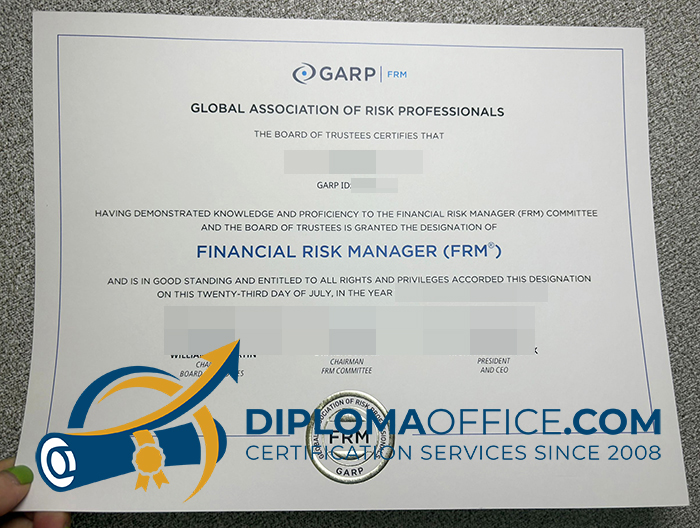
In the volatile global financial landscape, systematic risk management has become a core competency for financial institutions and industry practitioners. The Financial Risk Manager (FRM), administered by the Global Association of Risk Professionals (GARP), is the world’s most authoritative professional credential dedicated exclusively to financial risk management. Recognized across 190+ countries and trusted by mainstream financial institutions worldwide, this professional qualification validates practitioners’ rigorous professional ability to identify, measure, monitor and control various financial risks. The FRM Certificate has long been regarded as the gold standard for career advancement in the global risk management industry.
Core Definition and Industry Authority
Launched in 1996, the FRM program is specially designed for financial risk professionals, covering the most comprehensive and cutting-edge risk management knowledge system in the industry. Different from generalized finance certifications, it focuses precisely on quantitative risk analysis, risk modeling and practical risk response strategies. GARP’s official annual curriculum updates ensure the program keeps pace with evolving global financial regulations, emerging market risks and industrial innovation trends. Up to now, more than 97,000 certified FRM holders are practicing in global banks, asset management companies, hedge funds, consulting firms and financial regulatory agencies, forming a professional elite group in the risk management field.
Scientific Exam Structure and Assessment Standards
The FRM assessment adopts a rigorous two-part hierarchical exam system, focusing on combining theoretical knowledge with industrial practical application. Part One focuses on foundational capabilities, including risk management foundations, quantitative analysis tools, financial market rules and basic product valuation, examining candidates’ basic theoretical literacy and data analysis skills. Consisting of 100 multiple-choice questions within a 4-hour testing window, it lays a solid knowledge foundation for advanced risk management practice.
Part Two shifts to practical scenario application, covering core modules such as market risk, credit risk, operational risk, liquidity risk and investment risk management. With 80 scenario-based questions, it emphasizes assessing candidates’ ability to solve complex risk problems in real financial scenarios. There are no strict academic background restrictions for exam registration, making it inclusive for finance practitioners from diverse backgrounds. To obtain the official certification, candidates must pass both parts and accumulate two years of full-time professional experience in financial risk management within five years.
Practical Career Value and Application Scenarios
The biggest advantage of the FRM program lies in its strong industry pertinence and practical value. Certified FRM holders are competent for core risk positions including risk analyst, risk control manager, quantitative risk specialist, credit risk supervisor and financial compliance consultant. In the context of increasingly strict global financial supervision and frequent market fluctuations, financial institutions prioritize professionals with standardized risk management capabilities, making FRM certification a core competitive edge in job hunting, promotion and salary negotiation.
Moreover, the standardized knowledge system of FRM helps practitioners build a systematic risk thinking framework, enabling them to accurately capture potential risks in investment transactions, asset allocation and business operations, and formulate effective risk avoidance and mitigation plans. This professional capability is not only applicable to traditional financial institutions, but also widely valued in fintech enterprises, multinational financial groups and government financial regulatory departments.
Core Advantages in Industrial Competition
Compared with other generalized financial certifications, FRM features outstanding professionalism and vertical depth. It abandons broad and superficial financial knowledge and focuses entirely on the subdivision track of risk management, forming an irreplaceable professional barrier. Its global unified assessment standards and widespread institutional recognition ensure consistent professional competency recognition in global financial markets. For finance practitioners focusing on long-term development in the risk track, FRM is the most efficient credential to prove professional competence, expand industrial resources and enhance personal professional influence.