What Is NCFE: Foundation and Official Regulatory Status
NCFE is a prominent UK educational charity and awarding organisation with roots dating back to 1848. Originally established as the Northern Union of Mechanics’ Institutes, the institution evolved through multiple name changes. Though once short for Northern Council for Further Education, the acronym NCFE now operates as a standalone brand reflecting nationwide and international reach. Headquartered in Newcastle upon Tyne, it ranks among Britain’s largest vocational qualification providers.
Crucially, NCFE holds formal recognition from leading education regulators. It is regulated by Ofqual in England, recognised by Qualifications Wales and CCEA in Northern Ireland. This official oversight sets strict standards for curriculum design, assessment protocols and quality assurance. In 2015, NCFE merged with CACHE, a respected awarding body specialising in childcare and early education, significantly expanding its portfolio of sector-specific learning pathways. Every year, hundreds of thousands of learners complete accredited programmes via over 2,000 approved training centres, further education colleges and online learning providers across the UK.
Range of Programmes and Qualification Framework Alignment
NCFE designs and certifies hundreds of regulated vocational qualifications mapped to the Regulated Qualifications Framework (RQF). Programmes span Entry Level up to Level 7, covering an extensive spectrum of in-demand industries. Popular subject areas include health and social care, early years education, business administration, digital skills, sport, hospitality, and education and training. It also develops T Level technical qualifications and supports apprenticeship end-point assessment, closely collaborating with employers to ensure content matches real workplace requirements.
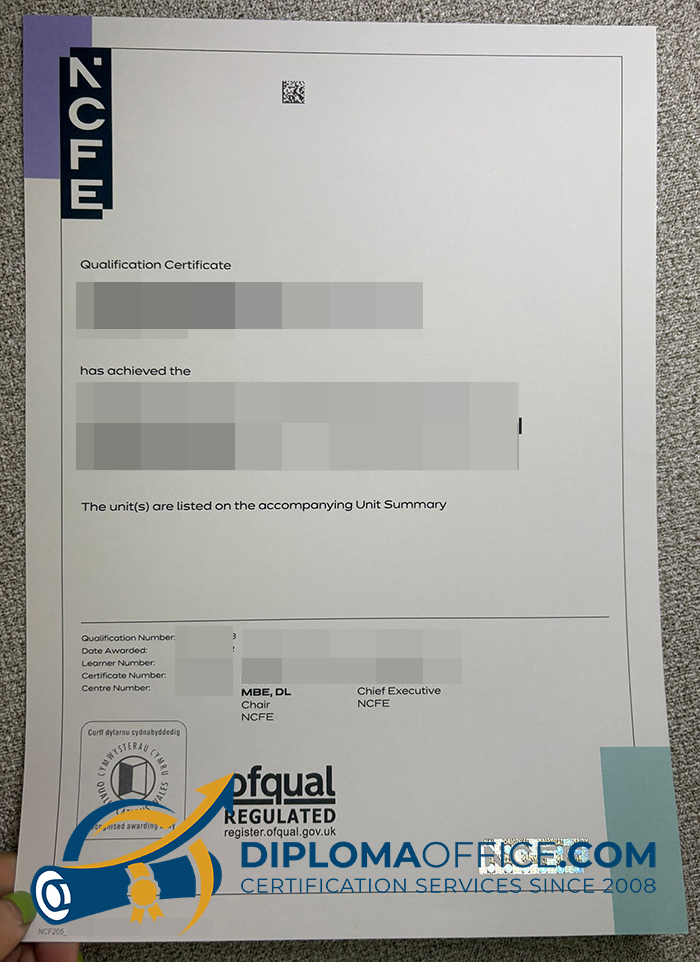
Two core qualification categories exist: regulated RQF awards and customised unregulated certifications. Regulated qualifications carry national benchmarked standards and may offer UCAS tariff points for university entry. Customised qualifications serve niche sectors where formal regulated awards do not yet exist, allowing training providers to create tailored learning validated by NCFE. Upon successfully meeting all assessment criteria for an approved course, learners receive formal documentation including an NCFE Certificate to verify their attained skills and competency level. Most assessments focus on practical portfolios, coursework and observational evaluation rather than traditional written examinations, suiting adult learners and career changers.
Employer and International Recognition
A common search question among prospective learners concerns how widely NCFE qualifications are accepted. Within the United Kingdom, public sector employers, care providers, education institutions and commercial organisations routinely recognise regulated NCFE awards for recruitment and internal promotion. Qualifications focused on health care, childcare and teaching hold particularly strong reputations within these regulated professions.
International recognition varies depending on qualification level and local immigration or employment rules. Many learners use NCFE vocational credentials to apply for skilled work visas in Commonwealth nations, though formal credential evaluation may be required. It is important to distinguish regulated RQF qualifications from shorter CPD or customised courses, as some overseas employers prioritise Ofqual-regulated awards. Learners planning to study or work abroad are advised to confirm local credential recognition requirements in advance with relevant authorities.
Who Should Choose NCFE Programmes
NCFE learning pathways suit distinct learner groups. Career switchers benefit from flexible, skills-focused courses that offer practical training without lengthy academic degrees. Existing workers can complete continuous professional development programmes to upskill or meet mandatory industry training requirements. Mature learners returning to education appreciate accessible entry criteria and assessment methods that prioritise applied knowledge over exam performance. School leavers can pursue technical alternatives to A-Levels through T Level qualifications administered by NCFE.
Compared to purely academic qualifications, NCFE programmes centre on occupational competence. This practical orientation explains their enduring popularity within vocational sectors. Prospective students should always verify whether a chosen programme carries full Ofqual regulation, as this impacts long-term employability, funding eligibility and global transferability.
Conclusion
As a historic, charity-led awarding body governed by strict national standards, NCFE remains a cornerstone of UK vocational education. Its balanced focus on employer needs and learner accessibility creates clear pathways for employment, promotion and further education. Anyone researching vocational training should compare regulated qualification status, course content and local industry demand before enrolling in any NCFE-accredited learning programme.