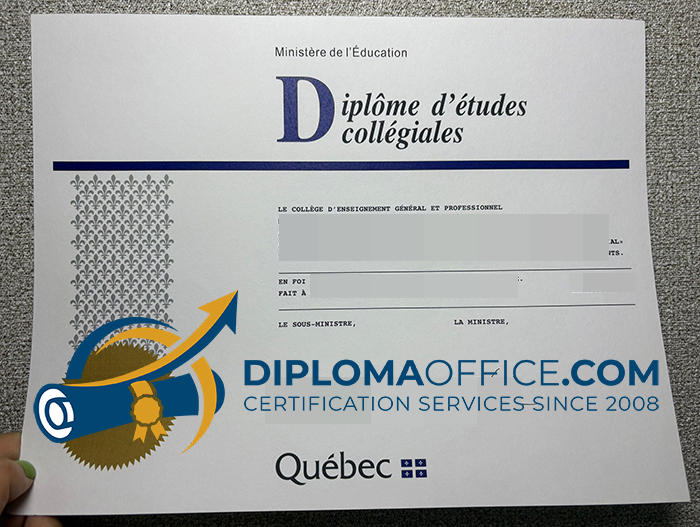
The Diploma of College Studies (DCS) is a standardized, government-recognized post-secondary credential exclusive to Quebec, Canada. Rooted in the province’s unique CEGEP (Collège d’enseignement général et professionnel) education system, it serves as a critical academic bridge between secondary school and university or professional employment. Regulated and issued by Quebec’s Ministry of Higher Education, this credential adheres to strict provincial academic standards, ensuring consistent quality and wide recognition across Canada and international education systems. Students who complete eligible programs and meet all graduation criteria will receive the official DCS Certificate, which validates their comprehensive college-level academic and technical competencies.
Core Definition and Educational Positioning
As a key component of Quebec’s structured education pathway, the Diploma of College Studies fills a vital gap between high school diplomas and undergraduate university degrees. Unlike generic college certifications, it is a formal, accredited qualification designed for two distinct educational tracks: pre-university and technical training. Pre-university DCS programs typically span two years, preparing students for direct admission to Canadian universities by equipping them with foundational academic knowledge equivalent to the first year of university studies. Technical DCS programs extend to three years, focusing on industry-specific practical skills to ready learners for immediate workforce entry while still retaining university transfer eligibility. This dual positioning makes the DCS a flexible, high-value credential for diverse academic and career goals.
Two Primary Program Types of DCS
DCS programs are categorized into pre-university and technical streams, each with tailored curricula and learning outcomes. Pre-university programs cover academic fields such as social sciences, natural sciences, arts, and literature. These programs prioritize critical thinking, research skills, and theoretical knowledge, laying a solid foundation for further undergraduate and postgraduate studies. They are ideal for students aiming to pursue long-term academic advancement in traditional university disciplines.
Technical DCS programs focus on vocational and applied training, covering in-demand fields including computer science, healthcare, aviation, business administration, and industrial technology. These programs integrate classroom theory with hands-on practical training, industry projects, and real-world internships. With 45 to 65 program-specific credit hours, technical DCS curricula are strictly aligned with industry standards, enabling graduates to possess job-ready competencies. Many technical DCS programs also support professional license applications, enhancing graduates’ employability in specialized industries.
Standard Admission and Graduation Requirements
To enroll in a DCS program, applicants must hold a valid Canadian secondary school diploma or an internationally recognized equivalent. International students need to provide academic credential verification and meet language proficiency requirements, with additional French competency standards for English-taught programs per Quebec’s educational regulations. During their studies, students must complete all required credit courses, pass uniform provincial examinations, and fulfill general education curriculum obligations.
Graduates typically receive their official credential three to four months after completing their final semester, verified and issued by their college’s registrar office under provincial government supervision. All graduation criteria are standardized by Quebec’s College Education Regulations, ensuring uniform credential validity across all accredited institutions.
Career and Academic Value of DCS
The Diploma of College Studies boasts authoritative recognition and practical value. For academic development, pre-university DCS holders can seamlessly transfer to top Canadian universities with advanced standing, shortening their undergraduate study cycle. For career development, technical DCS graduates qualify for entry-level to mid-level professional roles in their specialized fields, with higher industry recognition than ordinary vocational certificates.
Additionally, the DCS credential is widely accepted by Canadian employers and international education institutions. Its government-accredited status guarantees academic rigor and practical competence, making it a credible choice for students seeking flexible study paths, fast workforce entry, or streamlined university admission in Canada.