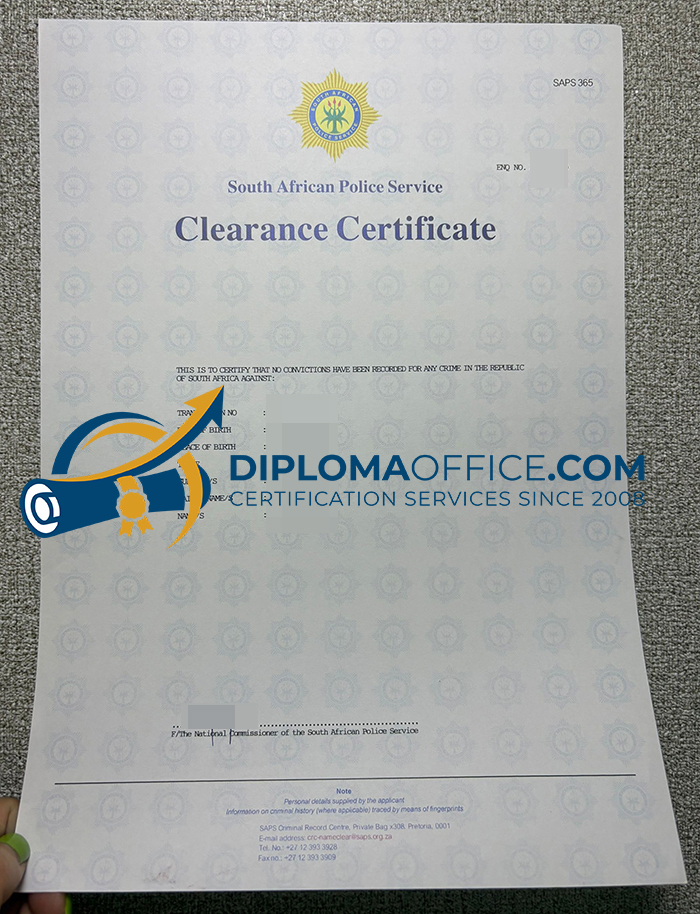
SA Police Clearance refers to an official criminal background verification issued by the South African Police Service (SAPS). It confirms whether an individual holds any recorded criminal convictions within South Africa’s national criminal database. The official formal document recognised by global immigration bodies, employers and professional regulators is the SA Police Clearance Certificate. This official record relies on fingerprint matching, making it far more reliable than name-only background checks and eliminating risks linked to shared names or identity confusion. It applies not only to South African citizens but also foreign nationals who have resided in South Africa for extended periods. Anyone who lived in the country for 12 months or longer is commonly required to obtain this clearance when submitting overseas official applications.
Common Scenarios Requiring SA Police Clearance
International mobility is the primary driver for requesting this document. Immigration authorities across Australia, Canada, the United Kingdom, New Zealand, the European Union and the Middle East routinely demand police clearance from every nation where applicants have previously resided. Permanent residency applications, citizenship submissions and long-term work visas all fall under this requirement.
Within employment, regulated sectors enforce strict background screening. Healthcare workers, educators, childcare staff, security personnel and financial practitioners must provide valid police clearance to receive professional registration. Many multinational companies also include this document in pre-employment checks for overseas assignments. Additional use cases cover international adoption, foster care applications, overseas volunteer roles and cross-border legal proceedings. Without this clearance, many formal applications risk suspension or outright rejection.
Application Requirements and Procedures
Fingerprint submission stands as a mandatory condition for every application. People currently residing in South Africa can visit any SAPS police station to complete fingerprint capture on the official SAPS 91(a) form. Applicants living overseas have two viable routes: arrange fingerprinting at local police authorities or schedule an appointment at a South African embassy or consulate. All fingerprint forms must bear the signature of the official who captured prints; digital scans or copied fingerprint forms will not be accepted.
Supporting documentation includes a certified copy of a passport or South African identity document. If applicants need maiden names or alternative surnames printed on the certificate, certified supporting documents such as marriage certificates must be attached. A fixed non-refundable administrative fee applies to each submission, payable via bank transfer or cash at domestic police stations. Applications are centrally processed at the SAPS Criminal Record and Crime Scene Management centre based in Pretoria; local stations cannot independently issue clearance documents. Processing durations differ significantly: domestic applications generally take 4 to 8 weeks, while overseas submissions often require 6 to 10 weeks due to international courier transit.
Validity, Apostille and Common Pitfalls
SAPS does not set a universal official expiry date, yet most foreign institutions recognise the document as valid for six months from its issuing date. Some embassies further narrow this window to three months, so applicants should coordinate timelines carefully and avoid applying excessively early. If the certificate will be used outside South Africa, most participating Hague Convention nations require apostille authentication through DIRCO, South Africa’s Department of International Relations and Cooperation. Authentication adds further processing time, which must be factored into overall planning.
Numerous applications face delays due to avoidable mistakes. Smudged fingerprints, mismatched names between identification and forms, missing certified documents and incorrect payment references rank among the most frequent errors. Applicants should note that once issued, certificates will only be retained by SAPS for three months; uncollected documents are destroyed automatically. Third-party agents can offer administrative support, yet all applicants remain ultimately responsible for verifying official requirements directly via SAPS public resources.
Final Tips for Applicants
Start the whole process at least three months ahead of any visa, immigration or employment deadline. Confirm specific requirements with the receiving organisation in advance, including whether apostille or sworn translation is necessary. Retain copies of all submitted materials, fingerprint forms and payment receipts for tracking enquiries. As official processes and administrative fees occasionally undergo adjustments, always cross-check the latest guidelines published on the official SAPS website before lodging an application.